
If your newly purchased property is particularly noisy, you may be entitled to compensation of around 20–30% of the property value, as supported by extensive Italian case law.
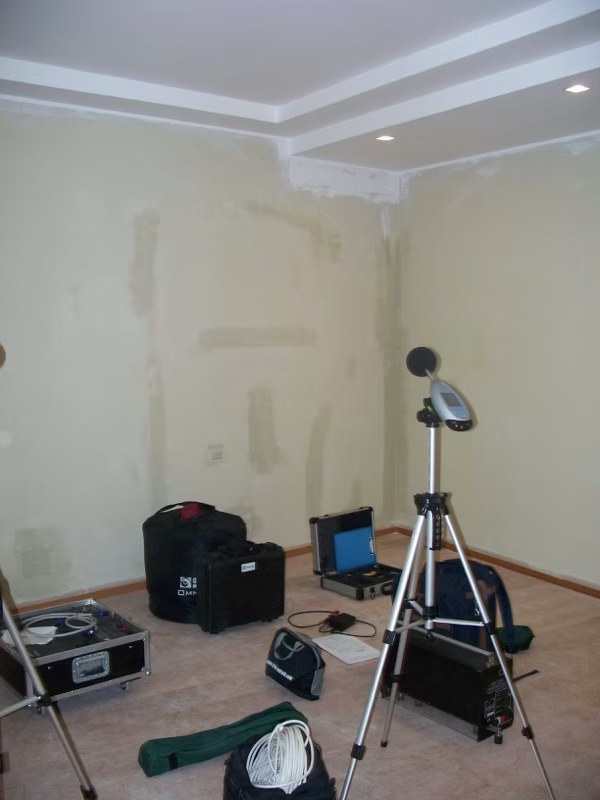
ARSolution can carry out professional acoustic measurements to assess compliance with the limits established by Italian acoustic regulations for the following building elements and systems:
Building Acoustic Performance
For new developments and existing buildings
- Airborne sound insulation between different properties
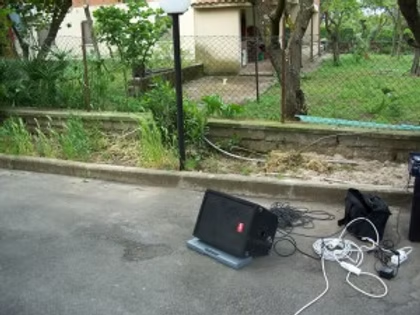
- Façade sound insulation
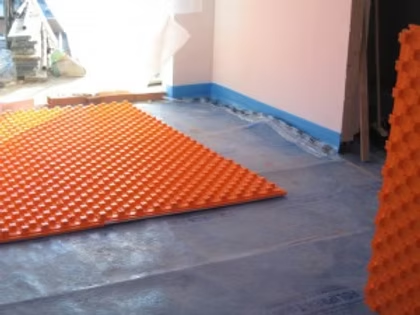
- Impact sound insulation between floors
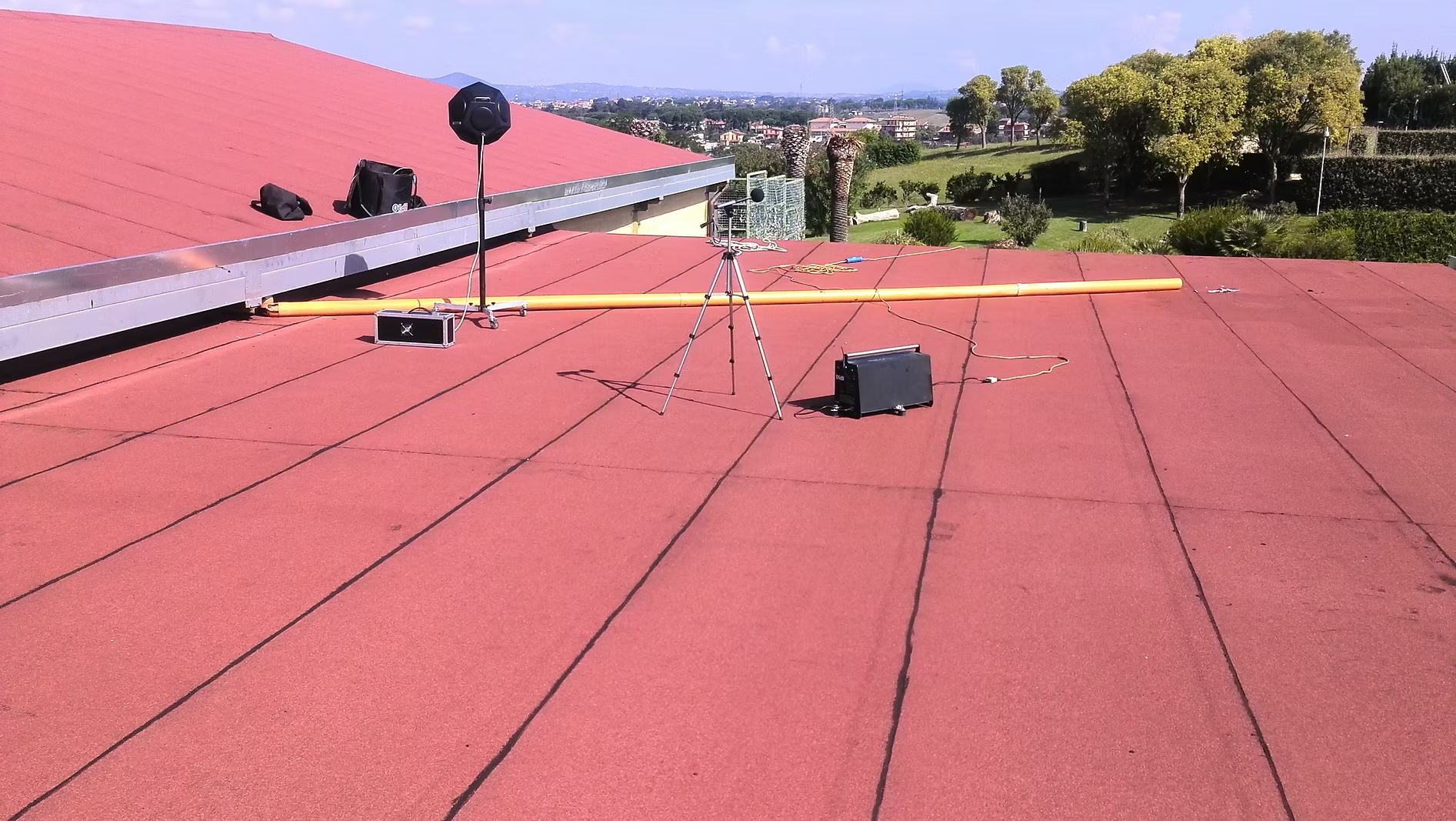
- Noise from continuously or intermittently operating building services
POTENTIAL COMPENSATION OF UP TO 30% OF THE PROPERTY VALUE
Noise can cause disturbance and adversely affect people in a wide range of environments. In urban areas, in particular, noise pollution is one of the most widespread environmental issues.
In most residential buildings, acoustic discomfort can originate from external sources — such as road or rail traffic and industrial activities — as well as from within the building itself, including lifts, building services, heating systems and neighbouring activities.
In many cases, relatively simple acoustic insulation measures can significantly reduce the disturbance, provided that the source of the problem is correctly identified.
Do you need an acoustic consultant for your renovation project?
Compliance with passive acoustic requirements in building renovations
Guidance from the Italian High Council of Public Works (Consiglio Superiore dei Lavori Pubblici): The D.P.C.M. of 5 December 1997 refers to buildings and their components in operation and does not specify that the legislation applies exclusively to new constructions. Consequently, according to the relevant guidance, compliance with passive acoustic requirements must also be ensured when renovation works affect building elements subject to these requirements, including the partial refurbishment of building services and/or horizontal or vertical partitions — floors, roofs, dividing walls, etc. — and external enclosures, excluding works limited exclusively to façades. The same applies to the subdivision of existing properties into multiple residential units.
Therefore, any renovation work involving parts of a building subject to passive acoustic requirements must comply with the limits established by the D.P.C.M. of 5 December 1997, as applicable to the specific case.
Therefore, any renovation work involving parts of a building subject to passive acoustic requirements must comply with the limits established by the D.P.C.M. of 5 December 1997, as applicable to the specific case.
For Designers and Construction Companies:
Compliance with passive acoustic requirements in building renovations
Achieving the acoustic performance required by law is neither difficult nor particularly costly when it is addressed during the design and construction stages. It becomes considerably more complex and expensive when corrective work has to be carried out after construction has been completed.
During the design phase, appropriate construction techniques make it possible to select low-thickness or cost-effective materials while ensuring the overall acoustic performance of the building.
Upon completion of the works, the Construction Manager certifies the building’s compliance, including compliance with hygiene and health requirements and the acoustic parameters set out in Table B of Annex A to the D.P.C.M. of 5 December 1997. For this purpose, the Construction Manager should rely on a qualified acoustic professional, who may also use the results of on-site measurements and testing.
During the design phase, appropriate construction techniques make it possible to select low-thickness or cost-effective materials while ensuring the overall acoustic performance of the building.
Upon completion of the works, the Construction Manager certifies the building’s compliance, including compliance with hygiene and health requirements and the acoustic parameters set out in Table B of Annex A to the D.P.C.M. of 5 December 1997. For this purpose, the Construction Manager should rely on a qualified acoustic professional, who may also use the results of on-site measurements and testing.
ARSolution provides acoustic classification services in accordance with UNI 11367
ARSolution provides technical acoustic consultancy for the design and construction of buildings in compliance with the D.P.C.M. of 5 December 1997, including:
• Baseline Noise Assessment
• Acoustic design, in collaboration with the appointed technical professionals, for floors, façades, internal partitions and plumbing systems serving bathrooms and kitchens, including the selection and specification of suitable materials
• Preliminary calculations for passive acoustic requirements in buildings
• On-site measurements during construction to verify correct installation
• Identification and design of any necessary corrective measures
• Acoustic works supervision, where required for warranty purposes
• Final testing for each apartment type
• Technical acoustic assessment based on test data